Valeo Bayen case through GAAR lens – when does tax planning become impermissible avoidance?
Introduction
The introduction of the General Anti-Avoidance Rule (GAAR) into the Indian Income-tax Act, 1961 represents a significant movement from formalistic tax planning toward a substance-based evaluation of commercial arrangements. GAAR is designed to address arrangements that may comply with the literal wording of the law but nevertheless produce a tax result inconsistent with the statutory purpose, commercial reality, or legislative intent.
This article examines the statutory architecture of GAAR and applies it to a corporate restructuring case involving an intra-group share transfer followed by a fast-track merger. The purpose is not to deliver a definitive judicial conclusion on the applicability of GAAR. Rather, it is to demonstrate how tax professionals may evaluate a complex restructuring through the dual lenses of the Main Purpose Test and the Tainted Element Test, while distinguishing between legitimate tax planning and arrangements that may be vulnerable to anti-avoidance scrutiny.
Factual Matrix: Valeo Bayen — ITAT Chennai, IT(TP)A No. 63/Chny/2023
The factual background is central to any GAAR analysis because the doctrine operates not merely on legal form, but on the commercial substance and sequencing of the arrangement. The case involved a French parent company that held investments in two Indian entities and undertook a restructuring that ultimately resulted in the consolidation of those entities.
Initial structure. The French parent company historically held a 60% equity stake in an Indian subsidiary, referred to here as Subsidiary 1. The remaining 40% was held by an independent joint venture partner. The French parent also held a 100% stake in another Indian entity, referred to here as Subsidiary 2.
Consolidation of ownership. In 2018, the French parent acquired the remaining 40% stake from the joint venture partner, thereby making Subsidiary 1 a wholly owned subsidiary. This acquisition was an important preparatory step because it enabled the parent group to undertake a subsequent internal restructuring without the involvement of an external shareholder.
Information limitations. The available case materials do not provide detailed information on the incorporation history, capital structure, operational profile, accumulated reserves, or financial performance of the two subsidiaries. Accordingly, the analysis proceeds on the facts available from the record and highlights where evidentiary gaps may influence the GAAR evaluation.
Share transfer. After the buyout of the joint venture partner, the French parent transferred its entire shareholding in Subsidiary 1 to Subsidiary 2 for a consideration of approximately INR 640 million. As a result, Subsidiary 2 became the direct holding company of Subsidiary 1.
Subsequent merger and share cancellation. Within approximately 12 to 18 months following the share transfer, Subsidiary 1 was merged into Subsidiary 2 through a fast-track merger scheme. Consequently, the shares held by Subsidiary 2 in Subsidiary 1 were extinguished and cancelled as part of the merger mechanics.
Funding of consideration. The French parent received the consideration from Subsidiary 2. The precise funding mechanics were not conclusively established in the judicial findings. For purposes of this analytical exercise, it may be assumed that Subsidiary 2 did not independently possess sufficient cash reserves and that the accumulated funds of Subsidiary 1 were effectively used post-merger to discharge the liability owed to the French parent. Even if Subsidiary 2 had independent funds, the core GAAR question would remain whether the chosen steps produced a tax outcome inconsistent with the purpose of the statutory exemptions relied upon.
Arguments and Tribunal Findings
The Taxpayer’s Position
The taxpayer relied on specific tax-neutrality provisions contained in Section 47 of the Income-tax Act, 1961. The central contention was that each legal step satisfied the conditions prescribed by the statute and therefore could not be taxed merely because it formed part of an internal group reorganisation.
Section 47(iv). The taxpayer claimed that the transfer of shares by the parent company to its wholly owned Indian subsidiary was not regarded as a transfer for capital gains purposes, provided the statutory conditions were satisfied.
Section 47(vi). The taxpayer also relied on the tax-neutral treatment available in respect of transfers of assets and liabilities arising from an amalgamation, including the consequential extinguishment or cancellation of shares.
The Revenue’s Contentions
The Assessing Officer challenged the exemption primarily on the ground that the restructuring lacked commercial necessity and was allegedly designed to move value to the foreign parent without an Indian tax charge. The Revenue advanced two principal arguments.
Allegation of a colourable device. The Revenue alleged that the sequence of transactions was a pre-arranged structure created to expatriate approximately INR 640 million to the French parent without payment of capital gains tax.
Characterisation of shares. The Revenue further contended that the shares were in the nature of stock-in-trade rather than capital assets. If accepted, this would have displaced the taxpayer’s reliance on Section 47(iv) and potentially subjected the receipt to taxation under a different head of income.
The Tribunal’s Decision
The Income Tax Appellate Tribunal ruled in favour of the taxpayer under the regular provisions of the Act. The Tribunal held that the Revenue had not produced sufficient evidence to establish that the arrangement was sham, artificial, or devoid of commercial substance.
The Tribunal also rejected the attempt to characterise the shares as stock-in-trade. The documentary record indicated that the shares were held as strategic long-term investments and constituted capital assets. Importantly, the Tribunal reaffirmed that tax authorities cannot substitute their own commercial judgment for that of a taxpayer or dictate the manner in which a business restructuring should be implemented.
Important caveat. The dispute was adjudicated under the regular provisions because GAAR was not formally invoked during assessment. Accordingly, the Tribunal did not examine whether the same arrangement, if evaluated under Chapter X-A, could have satisfied the statutory thresholds for an Impermissible Avoidance Arrangement.
Statutory Framework of GAAR
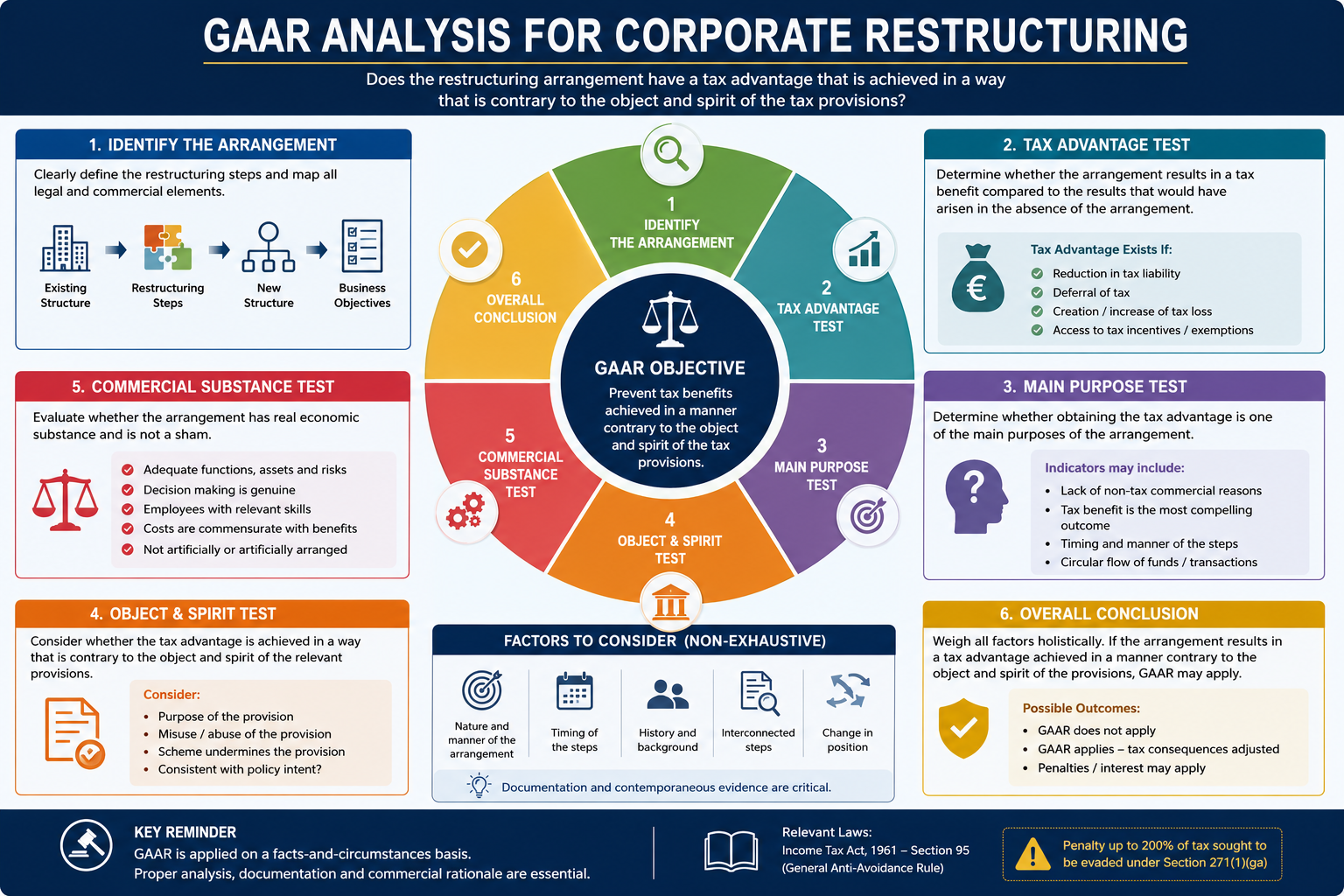
GAAR is triggered when an arrangement is capable of being characterised as an Impermissible Avoidance Arrangement. Broadly, this requires two cumulative elements: first, the main purpose of the arrangement, or of a step within the arrangement, must be to obtain a tax benefit; second, the arrangement must contain at least one tainted element, such as misuse or abuse of the Act, lack of commercial substance, non-arm’s length rights or obligations, or a manner of implementation not ordinarily employed for bona fide purposes.
Step-by-Step GAAR Analysis
Step 1: Identifying the Arrangement — isolated steps or composite transaction?
The threshold issue is whether the sequence of events should be analysed as separate and independent transactions or as a single integrated arrangement. The relevant steps include the acquisition of the remaining 40% stake from the joint venture partner, the transfer of the entire shareholding in Subsidiary 1 to Subsidiary 2, and the subsequent merger of Subsidiary 1 into Subsidiary 2. Even if the first step is excluded, the share transfer and merger appear closely connected in purpose, timing, and outcome.
During the proceedings, the taxpayer itself clearly stated that the share transfer was undertaken to facilitate the fast-track merger and that the ultimate objective was to consolidate Subsidiary 1 and Subsidiary 2. As no independent commercial rationale existed for interposing Subsidiary 2 as the immediate holding company of Subsidiary 1 before the merger, the steps may be viewed as part of one cohesive restructuring plan. From a GAAR perspective, the step-transaction approach becomes relevant because the statute permits scrutiny of the arrangement as a whole as well as any step or part of it.
Step 2: Main Purpose Test — was the dominant objective to obtain a tax benefit?
The Main Purpose Test requires a careful examination of whether the principal purpose of the arrangement, or of any step within it, was to obtain a tax benefit. In this case, the apparent tax outcome was significant as the French parent received approximately INR 640 million while relying on statutory provisions that treated the relevant transfers as tax-neutral.
Step 3: Tainted Element Test
Once an arrangement is identified, the next inquiry is whether it contains any tainted element prescribed under GAAR. For the present analysis, the most relevant elements are misuse or abuse of the provisions of the Act and lack of bona fide business purpose.
- Misuse or Abuse of the Provisions of the Act
The taxpayer relied on Section 47(iv) and Section 47(vi) to claim tax neutrality for two connected steps: the transfer of shares of Subsidiary 1 to Subsidiary 2 and the subsequent merger of Subsidiary 1 into Subsidiary 2. On a purely textual reading, the conditions of these provisions may appear to have been satisfied. However, GAAR requires a broader inquiry that moves beyond literal compliance.
For GAAR purposes, the provisions relied upon by the taxpayer must be examined through three interpretive lenses: textual, contextual, and purposive[1]. The textual inquiry asks whether the statutory conditions are met. The contextual inquiry examines how those provisions operate within the wider capital gains tax framework. The purposive inquiry considers whether the arrangement frustrates the object and purpose for which the provisions were enacted.
Under the textual analysis, the taxpayer may contend that the conditions of Section 47(iv) and Section 47(vi) were fulfilled. The more difficult question arises at the contextual and purposive levels. Section 47 operates within the capital gains tax regime by identifying specific transactions that are not treated as transfers. Many such provisions are intended to facilitate genuine corporate reorganisations where ownership continuity is preserved and immediate taxation is deferred rather than permanently avoided through the extraction of cash value.
In a typical tax-neutral amalgamation, the shareholders of the amalgamating company receive shares of the amalgamated company. The economic value remains within the corporate structure, and taxation is generally deferred until a future taxable disposal. By contrast, the present arrangement may be viewed as producing an immediate cash extraction by the foreign parent while simultaneously relying on provisions intended for tax-neutral reorganisations. This distinction is central to the possible allegation that the provisions were used in a manner inconsistent with their legislative design.
One way to test whether the statutory purpose has been frustrated is to compare the impugned arrangement with a commercially feasible alternative that could have achieved the same business objective without producing the same tax result[2]. Such an alternative should be legally available, commercially realistic, economically comparable, and not itself abusive:
- The alternative transaction must be available under the Income-tax Act.
- It must not be so remote or impractical that it is commercially unrealistic.
- It must have a high degree of commercial and economic similarity to the arrangement under review.
- It must produce tax consequences that are broadly comparable for a genuine restructuring, without relying on abusive sequencing.
- It must not itself be vulnerable to GAAR.
In the present case, the most obvious alternative would have been a direct merger of Subsidiary 1 into Subsidiary 2 under the statutory amalgamation framework. If implemented as a conventional merger with consideration in the form of shares, the transaction could have achieved consolidation while maintaining the tax-deferral character contemplated by the restructuring provisions. However, if the same economic consolidation were accompanied by a cash payout to the shareholder, the tax treatment could differ materially.
Accordingly, although the taxpayer may have satisfied the literal requirements of the provisions relied upon, the GAAR inquiry asks whether the sequence was designed to convert what should have been a tax-deferred share-based reorganisation into an immediate tax-free cash extraction. If that is established on evidence, the arrangement may be susceptible to being characterised as a misuse or abuse of the Act.
A transaction may be considered abusive when it uses statutory language to achieve a result that contradicts the legislative intent underlying that provision. In this context, the critical question is not merely whether the taxpayer complied with the words of Section 47, but whether the arrangement respected the purpose of the exemption regime.
A possible counter-argument is that the taxpayer was entitled to structure the restructuring through two separate legal steps: first, a transfer of shares, and second, a merger. Since the Act contains specific exemption provisions that may apply to each step if the prescribed conditions are met, the taxpayer may contend that the form chosen should be respected. However, in a GAAR analysis, this argument is persuasive only if the steps can be shown to have independent commercial significance and if their combined effect is consistent with the purpose of the exemption provisions.
- First, the share transfer and the merger would need to be capable of being viewed as separate and commercially meaningful transactions. The taxpayer would therefore have to demonstrate a bona fide business purpose for transferring the shares to Subsidiary 2 before the merger, beyond merely enabling the use of the fast-track merger route. The fact that fast-track merger may be a quicker process explains the manner in which the merger was implemented, but it does not, by itself, explain why an intermediate share transfer for cash was commercially necessary.
- Second, if the share transfer and merger are viewed as one integrated arrangement designed to achieve consolidation, the nature of the consideration becomes important. Had the consideration for the share transfer been discharged by issuing shares of Subsidiary 2, the corporate value would have remained within the Indian structure, and the transaction would have more closely resembled the tax-deferral rationale underlying the amalgamation provisions. By contrast, a cash consideration paid to the foreign parent may support the argument that the sequencing converted a tax-neutral reorganisation into a tax-free extraction of value.
- Bona Fide Business Purpose and Commercial Substance
The presence of bona fide business purpose (synergy effect) must be evaluated from the taxpayer’s perspective, but it must nevertheless be supported by credible evidence. Relevant indicators may include operational integration, elimination of duplicated functions, simplification of governance, cost savings, improved management efficiency, regulatory convenience, or strategic business consolidation.
If the cash reserves of Subsidiary 1 were used after the merger to fund the consideration payable by Subsidiary 2 to the French parent, that fact could strengthen the perception that the restructuring facilitated extraction of value rather than operational consolidation. This would not automatically prove GAAR applicability, but it would become a material circumstance in evaluating commercial substance.
Valuation also assumes significance. The reported movement in share value from INR 55 per share during the joint venture buyout to INR 75 per share during the intra-group transfer within a relatively short period may require careful explanation. Where a Discounted Cash Flow valuation is adopted for an entity that is expected to be legally merged out of existence shortly thereafter, the assumptions underlying the going-concern valuation should be examined with particular care.
If a taxpayer is unable to demonstrate a credible commercial rationale for the chosen sequencing, the absence of bona fide purpose may support the inference that the arrangement was principally designed to obtain a tax benefit and thereby satisfying the main benefit test. Conversely, if the taxpayer can produce robust business evidence supporting the restructuring, the GAAR risk may be substantially reduced even where a tax benefit arises incidentally.
Integrating the Main Purpose and Tainted Element Tests
The Main Purpose Test and the Tainted Element Test should not be analysed in isolation. They often reinforce each other. A transaction that lacks commercial substance may suggest that its dominant purpose was tax-driven. Similarly, evidence of cash extraction, circular sequencing, or purposive frustration of the statutory scheme may strengthen the conclusion that the arrangement was not merely tax-efficient but potentially impermissible.
In the present case, the regular provisions supported the taxpayer because the Revenue failed to establish that the transaction was a colourable device or that the shares were not capital assets. However, a GAAR inquiry would require a more searching analysis of the entire arrangement, including whether the legal steps were selected primarily to obtain a tax benefit and whether the transaction achieved a result inconsistent with the object of Section 47.
Conclusion
The Valeo Bayen fact pattern illustrates the fine line between legitimate restructuring and arrangements that may invite anti-avoidance scrutiny. The Tribunal’s decision confirms that taxpayers are entitled to choose a lawful and commercially preferred route, and that tax benefit alone cannot invalidate a transaction. Yet, GAAR changes the analytical lens: it asks whether the arrangement, viewed as a whole, respects not only the letter of the law but also its purpose, context, and commercial substance.
For tax professionals, the lesson is clear and compelling: documentation of business rationale is no longer a procedural formality; it is the foundation of defensible tax planning. In an era where substance increasingly prevails over form, every restructuring must be capable of answering a simple but decisive question: if the tax benefit were removed, would the transaction still make commercial sense and whether the tax benefit obtained is exactly how the legislation intended? The strength of that answer may determine whether a transaction is remembered as prudent corporate planning or challenged as an impermissible avoidance arrangement.
Disclaimer: This article is intended solely for educational and informational purposes and should not be construed as legal, tax, accounting, financial, or professional advice. Readers should not act, refrain from acting, or make any decision on the basis of the contents of this article without seeking appropriate professional advice tailored to their specific facts and circumstances. The author shall not be responsible or liable for any loss, damage, consequence, or action taken or omitted to be taken by any person in reliance on this article. Any reference to the Tribunal decision or related case law has been included only as a case study to set out the relevant facts and facilitate academic discussion, and should not be understood as expressing any opinion, determination, or decision on the merits or outcome of that case.
[1] Wuswig Inc. 2025 TCC 147 Tax court of Canada
[2] Univar Holdco Canada ULC v Canada, 2017 FCA 207