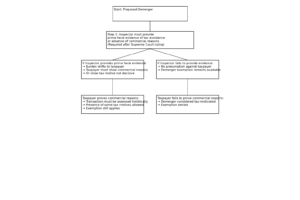

Facts:
Mukesh Sehgal (MS) and Promila Sehgal (PS), UK‑resident but non‑UK domiciled individuals, sold their majority shareholding in Visage Holdings Limited (VHL) in September 2005 as part of family succession planning. Most of the consideration was received in guaranteed unsecured loan notes issued by a UK company, Visage Group Limited (VGL) which was incorporated to acquire the shares of VHL.
The loan notes were redeemable after six months and were deliberately structured not to be qualifying corporate bonds. Taxpayers obtained professional advice that, prior to redemption, VGL could substitute an offshore subsidiary as debtor so that the loan notes would become foreign‑situated assets, allowing redemption without UK capital gains tax under the remittance basis.
In April–May 2006, a Jersey company (Manakin Limited) was incorporated and substituted as debtor under the loan notes shortly before redemption. The redemption proceeds were paid into MS and PS’s Jersey bank account in May 2006.
MS and PS’s 2006‑07 tax returns disclosed the redemption but treated the gains as non‑taxable under remittance basis principles. HMRC later assessed UK CGT and imposed negligence penalties, arguing that the loan notes remained UK‑situated because they were not “registered” in Jersey at redemption.
Legal issue:
Whether, at the time of redemption in May 2006, the loan notes were “situated outside the United Kingdom” for the purposes of the UK capital gains tax law. This depended on whether the loan notes were “registered debentures” and, if so, whether they were registered in Jersey. A secondary issue was whether MS and PS were negligent in submitting incorrect capital gains tax returns, justifying penalties.
Note:
UK‑resident but non‑UK domiciled individuals are, under s.12 TCGA 1992, not charged to UK CGT on gains from the disposal of assets situated outside the UK, unless the proceeds are remitted to the UK (the remittance basis).
For debts and loan notes, situs is determined by s.275 TCGA. Registered debentures are situated where they are registered; unregistered debts are generally situated where the creditor is resident. Therefore, unless a loan note is genuinely registered outside the UK in an identifiable register, it will normally remain UK‑situated for a UK‑resident creditor, exposing the gain to UK CGT regardless of remittance.
Revenue’s arguments:
- The loan notes were not “registered” in Jersey at the time of redemption.
- Internal accounting records or trial balances of Manakin Limited did not constitute a “register”.
- A register must be a formal, identifiable record created for that purpose, not accounting working papers.
- No Jersey register existed at redemption; the only formal register was the original UK register maintained by VGL.
- Accordingly, the loan notes were UK‑situated and chargeable to UK CGT.
- MS and PS were negligent in filing incorrect returns by failing to ensure that the tax planning steps (including registration) were properly implemented.
Tribunal’s decision:
The Tribunal held that a “register” requires a degree of formality, specificity, and purpose beyond merely being a record. It must operate as an authoritative, identifiable point of reference.
The alleged Jersey “register” consisted only of later‑created accounting records and trial balances. There was no evidence those records even existed at the time of redemption, nor that they were intended to serve as a register. By contrast, the original UK register created under the loan note deed clearly met the characteristics of a register.
Accordingly, the loan notes were either unregistered (falling within s.275(1)(c)) or registered only in the UK register. Either way, the loan notes were UK‑situated at redemption.
On penalties, however, the Tribunal found that MS and PS had relied reasonably on professional advisers to design, implement and report the transactions. In such complex circumstances, that reliance amounted to reasonable care, so negligence penalties were not justified.