This content is for Subscriber members only.
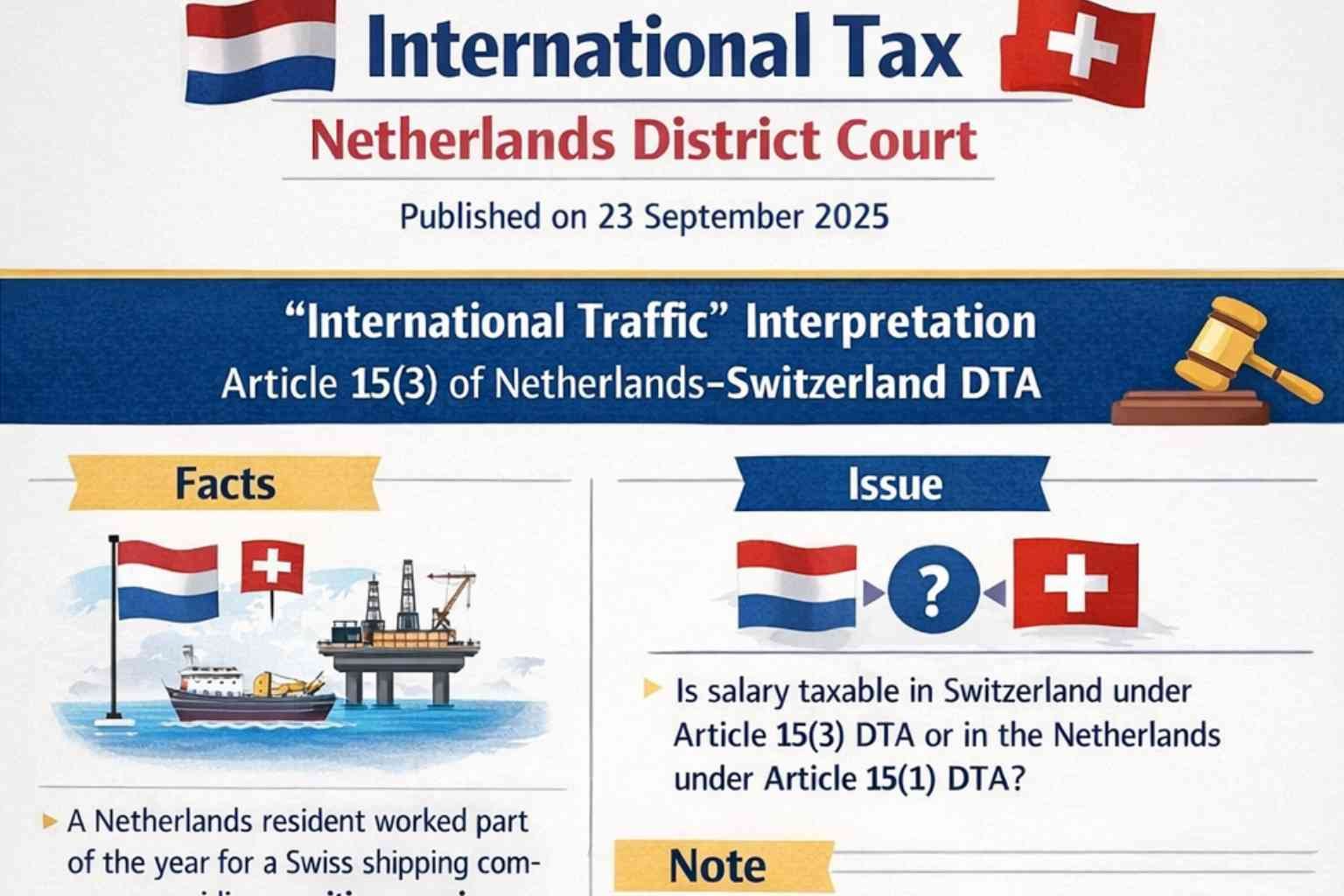
“International traffic” interpretation – Article 15(3) of Netherlands-Switzerland DTA
Facts:
During the disputed year, an individual was resident in the Netherlands and employed by a Swiss-based shipping company. The individual spent part of the year working in international waters, where the company’s vessels provided maritime services to clients in the oil and gas sector, including pipeline installation and the decommissioning of drilling platforms.
Issue:
The central question is whether the salary should be taxable in Switzerland under Article 15(3) of the Double Taxation Agreement (DTA), or solely in the Netherlands pursuant to Article 15(1) of the DTA.
Note:
Article 15(3) supersedes Articles 15(1) and 15(2), stating that remuneration for employment aboard ships or aircraft operated in international traffic or inland waterway vessels may be taxed in the jurisdiction where the undertaking’s place of effective management is located, which in this case is Switzerland.
“International traffic,” as defined in Article 3 of the DTA, refers to all carriage by ship or aircraft managed by an undertaking based in a Contracting State, except when such operations are conducted exclusively between locations in the other Contracting State.
Decision:
The court determined that the individual’s salary is taxable only in the Netherlands under Article 15(1) and Article 15(3) is not applicable. The rationale included:
- The text of Article 8 (profits of shipping and aircraft companies) and Article 15(3) aligns with the OECD Model Convention 2008, making its commentary significant for interpreting relevant terms.
- The OECD commentary on Article 15 of the 2008 Model Convention establishes that the allocation rule in Article 15(3) is connected to the principle in Article 8 of the Convention.
- Commentary on Article 8 clarifies that benefits from operating ships in international traffic pertain to profits directly related to the commercial transport of passengers and goods, along with associated activities.
- In this particular case, since the vessels were engaged in pipeline laying rather than the transportation of passengers or goods, it could not be concluded that the company was conducting operations in international traffic. Any movement of persons or goods was merely incidental to the primary activity of pipeline laying; accordingly, Article 15(3) does not apply.
In conclusion, the court held that the individual’s remuneration should be taxed exclusively in the Netherlands.
#InternationalTax