This content is for Subscriber members only.
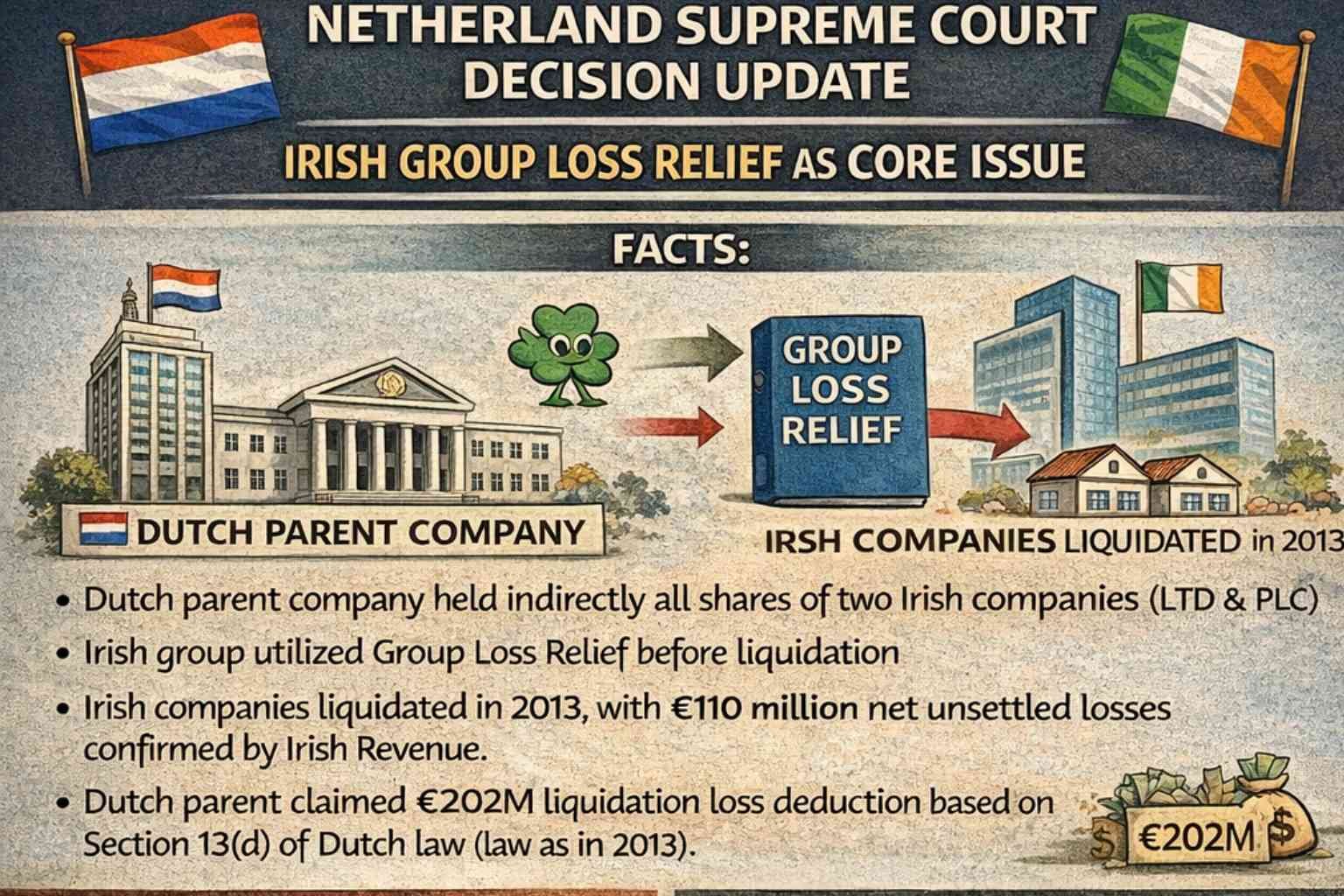
With Irish group loss relief as core issue
Facts: A Dutch parent company held indirectly all the shares of two Irish incorporated and resident companies (a PLC and an LTD company), which qualified for participation exemption in the Netherlands. The PLC utilized Group loss relief (section 411 of TCA1997) and transferred the losses to the Irish group companies during its existence before 2013. In 2013, both the Irish companies were liquidated. At the time of completion of the liquidation process, the Irish companies had net losses of around €110 million as unsettled losses, which could not get relief in any other way and was confirmed by Irish tax authorities.
The Dutch parent company claimed the net liquidation loss of €202 million (computation mechanism in below para) as a deduction arising from the liquidation of the two Irish companies.
According to section 13(d) of the Corporation Tax Act 1969 (law as in 2013) of the Netherlands, the liquidation loss was calculated as the amount of investments in the participations (two Irish companies) which exceeds the liquidation proceeds. One critical condition to avail this liquidation loss is that the losses in the participations remain unsettled and are not entitled to setoff or any concession/compensation in any other way after the completion of liquidation.
Revenue’s argument: The condition of “non-entitlement of any concession/compensation with respect to losses” should be assessed not only at the time of liquidation completion but throughout the existence of the liquidated entity up to and including the time of liquidation completion. Therefore, as the liquidated company utilized the group loss relief under Irish law during its existence, the liquidation loss relief under Dutch corporation tax law should not be allowed to the Dutch parent company.
Supreme Court Ruling: According to the intention of the legislature and the language of section 13(d)(9), the condition of “no entitlement to any compensation” must be assessed according to the situation at the time of liquidation. This implies that only if there is a right to any compensation regarding unsettled losses at the time when the liquidation is completed, can deduction of a liquidation loss be refused in the hands of Dutch parent company.
As the Irish Revenue Authority confirmed that the unsettled loss in the hands of the liquidated company is totally lost on the date of completion of the liquidation, no relief would be allowable in any other way concerning the losses.
The Supreme Court also observed that this mechanism might create a situation where double loss could be claimed. However, they acknowledged that this situation is inherent in the design of the liquidation loss scheme under the corporate tax law.