
This content is for Subscriber members only.
Retroactive application of domestic law amendment into DTA with Germany and New Zealand
Facts:
Australian taxpayer companies controlled by a German entity were classified as foreign under state land tax law and faced higher land taxes in 2020-21 and 2021-22 as compared to the domestic controlled Australian companies. They relied on Article 24 of the Australia-Germany Double Taxation Agreement (DTA), which covers all taxes imposed in Australia even those not listed under “Australian tax” in Article 2 (Income tax and fringe benefits tax).
Section 5(1) of the International Tax Agreements Act 1953 (Commonwealth law) implemented this DTA (including article 24) into Australian law, creating inconsistency with state land tax laws taxing foreign-controlled companies more heavily. Under s109 of the Constitution, Commonwealth law prevails over the state laws in case of such conflict. S5(1) of the commonwealth law was supported by the powers under s51(xxix) of the Constitution.
In April 2024, section 5(3) was added to the commonwealth law to restrict the DTA’s application only to “Australian tax,” excluding other taxes (including state land tax) from Treaty protection for liabilities after 1 January 2018.
Issue:
The central question was whether this amendment is supported by the Constitution and whether it could be applied retroactively from January 2018.
Court’s Decision:
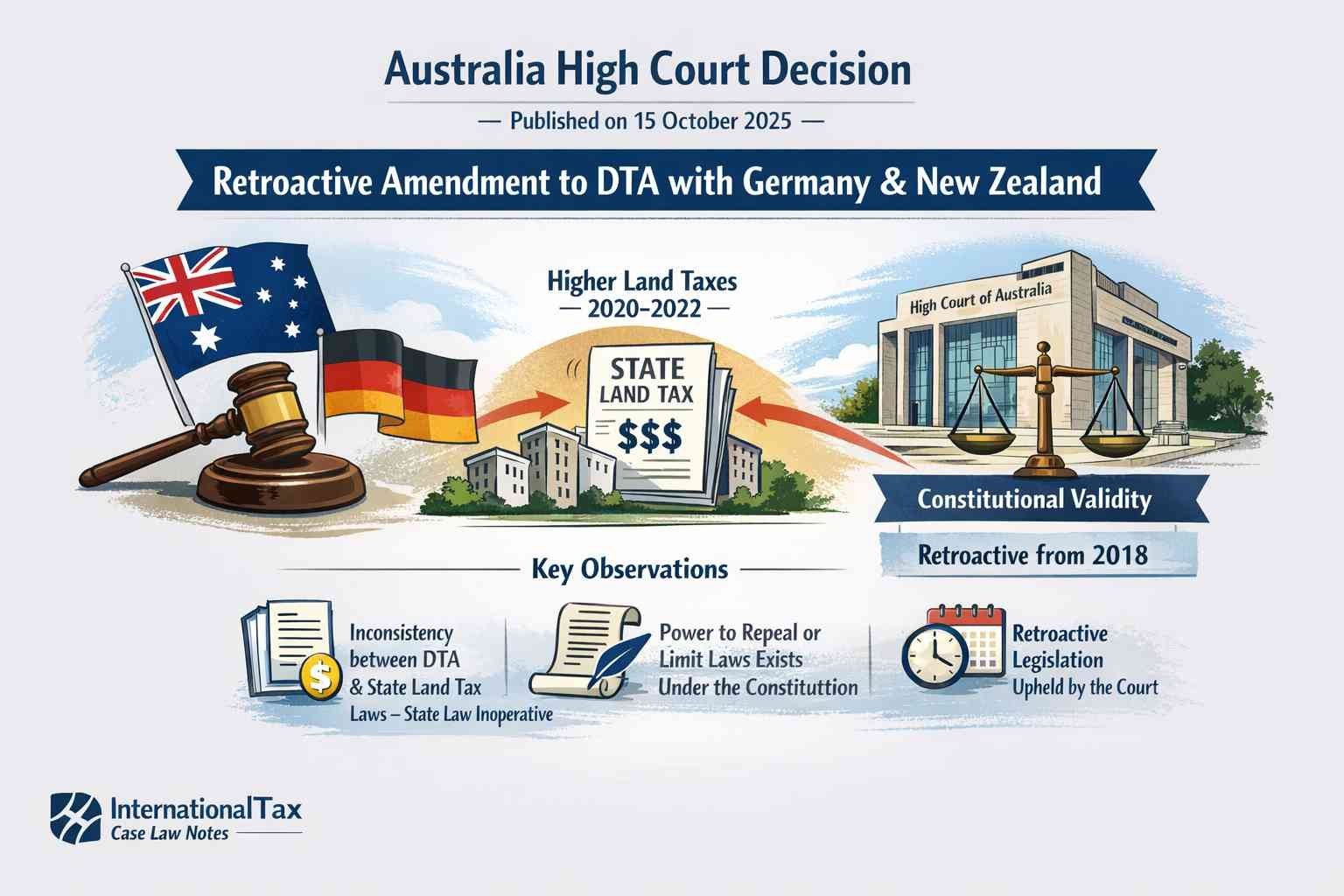
The High Court found that the amendment was constitutionally valid and could be retroactively applied from 2018. Therefore, Australian tax authorities were justified in imposing the additional tax on the taxpayer companies. Key observations from the court include:
- The inconsistency between Article 24 of the DTA, as incorporated by s5(1) of the Commonwealth law, and the higher rates imposed by state land tax regimes, is a direct inconsistency. This does not make the state law provisions void but only inoperative.
- The power to make laws [under s51(xxix) of the Constitution in this case] includes the power to repeal or limit them; thus, a law that repeals or restricts an earlier valid law is generally supported by the same constitutional authority provided there is no constitutional limitation preventing such repeal or restriction.
- There is no constitutional limitation preventing such restriction on the scope of s5(1) of the Commonwealth law. The core provisions of agreements like Article 24 can still apply even if limited to Australian tax, and s5(1) continues to implement these agreements into domestic law regarding Australian tax. S5(3) merely narrows the application of Article 24 within domestic law. Despite this restriction, s5 of the commonwealth law remains suitably adapted to implement the German Agreement. In other words, any limitation is not so significant as to deprive section 5(1) of its status as a measure implementing the agreement.
- The amendment through section 5(3) of the Commonwealth law has retroactive application, as indicated by the explanatory memorandum to the amendment and distinguishing the Metwally’s case. Para 61 to 74 and 90 to 96 are very relevant on retroactive application.