This content is for Subscriber members only.
Dual resident companies – Can TRC be rejected?
In a recent case before India’s Tax Tribunal involving eBay Singapore, the central question was whether capital gains from share transfers should be taxed in Singapore under Article 13(5) of the India-Singapore Double Taxation Agreement (DTA). The Tribunal decided in favour of the taxpayer. However, the Indian Revenue Authority (IRA) argued that the India-USA DTA should apply since, according to them, the Singapore-based company’s place of management was actually in the US. Ultimately, the Tribunal ruled for the taxpayer, who demonstrated that the company was indeed managed from Singapore.
Now, imagine a situation where a company’s place of management is genuinely in a third country. Can the IRA disregard a Singapore Tax Residency Certificate (TRC) and deny treaty benefits under the India-Singapore DTA?
In general, the answer is no, with one exception.
It’s well established that countries have to refer to their own bilateral treaty (India-Singapore) as far as article 4 is concerned and not required to refer to any agreements either country might have with third countries. As a result, India must grant treaty benefits if the company meets the requirements of Article 4 of India-Singapore DTA which it did in this case.
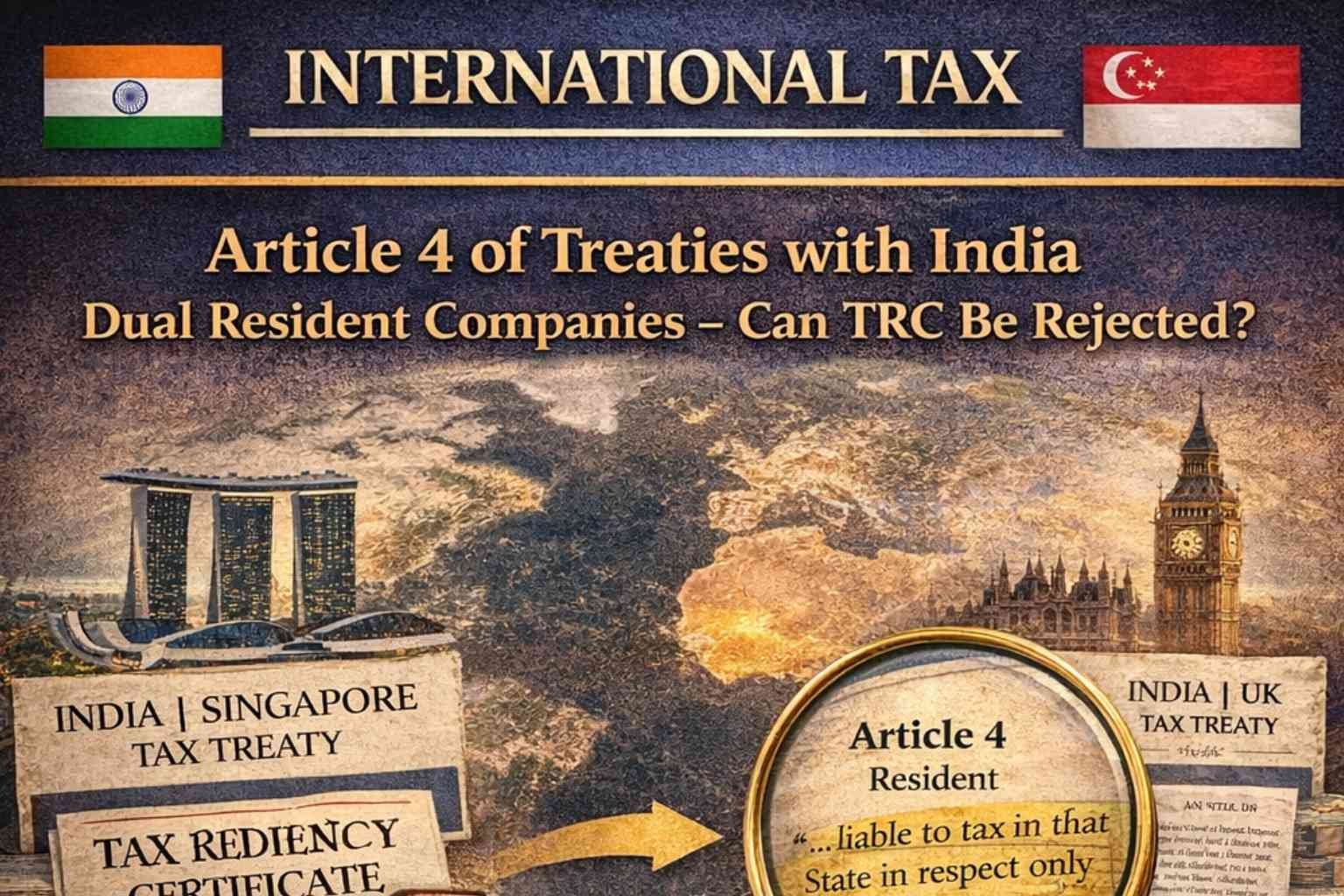
The exception arises if Article 4(1) of the DTA contains the second sentence found in the model tax treaty, as shown below:
“………This term, however, does not include any person who is liable to tax in that State in respect only of income from sources in that State or capital situated therein.”
For instance, the India-UK DTA includes this second sentence, which means a company considered resident in the UK under domestic law can be regarded as deemed non-resident if it loses the tie-breaker test under Article 4 in the UK’s DTA with another country (where its management is located). Paragraph 8.2 of the OECD/UN commentary addresses this scenario.
This usually concerns cases where a company is deemed resident in both the UK and a third country, but after losing the tie-breaker test, it is taxed in the UK only on income sourced there, invoking the second sentence of Article 4(1) of the India-UK DTA. In such cases, the IRA can reject the TRC from the UK and deny treaty benefits, instead applying the DTA between India and the third country. Since the India-Singapore DTA omits this second sentence in Article 4(1), the IRA must accept the TRC from Singapore and provide treaty benefits to Singapore-incorporated companies.
Interestingly, some countries, like Ireland and the UK, classify a company as deemed non-resident under their domestic law itself if it loses the tie-breaker test with another country. In these situations, India can deny treaty benefits even if the DTA omits the second sentence as such companies are non-residents domestically and thus do not meet Article 4 requirements under the India-UK or India-Ireland DTAs.
#InternationalTax